-
Written by
Charlie Cowan
-
Published on
Dec 17, 2025
Share On
You've mastered the basics of AI. You're getting answers, solving problems, moving faster.
Now there's a next level: turning AI from a helpful assistant into a strategic sparring partner that challenges your thinking and remembers your context.
The difference? Skills.
What Leaders Are Missing About AI
Executives I talk to have found their AI rhythm: Open ChatGPT or Claude, ask a question, get a solid answer, move on. It works.
But there's another dimension most haven't discovered yet.
You can teach AI your processes, your frameworks, your way of thinking. Then every conversation becomes a coaching session, not a Q&A.
Claude skills make this possible. And you don't write a single line of code.
From Executive Assistant to Strategic Partner
Think about the difference:
Executive assistant approach:
- "Update our pricing strategy"
- AI gives you a pricing framework
- You implement it
- Next month, you start from scratch again
Strategic partner approach:
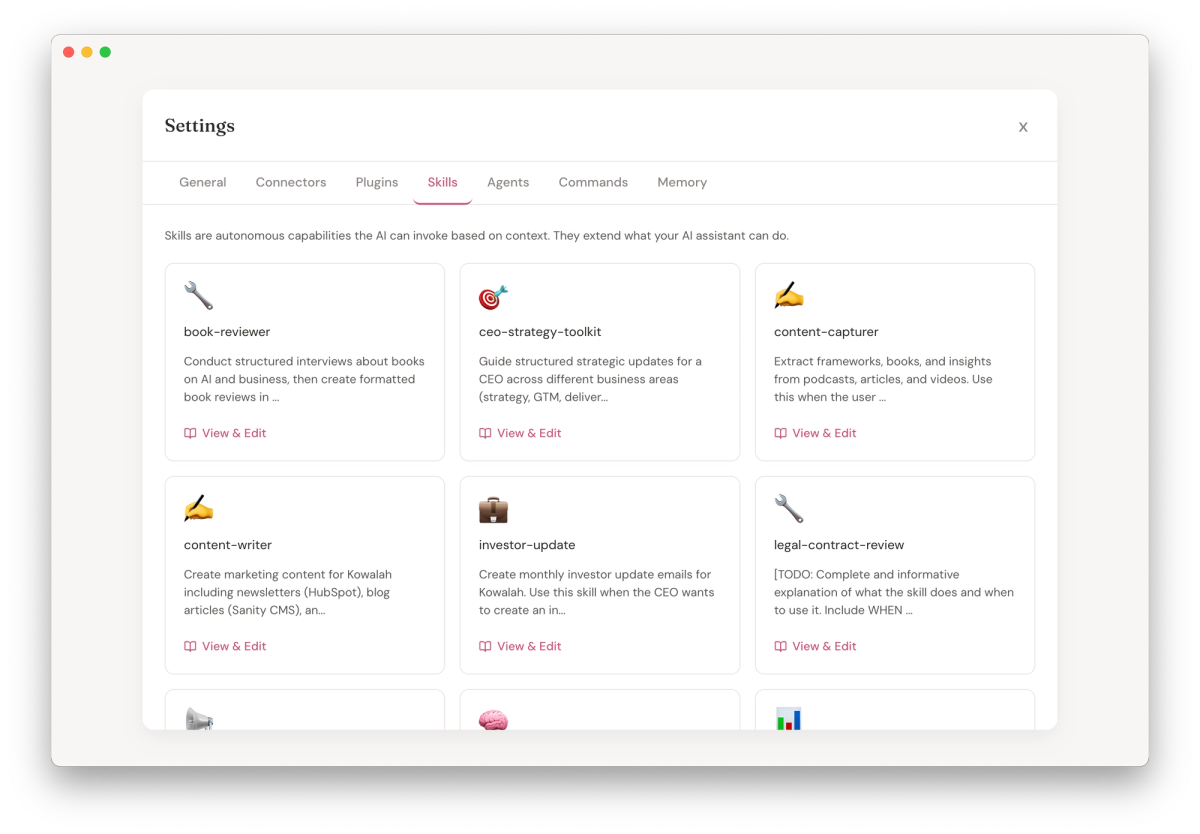
- You've built a CEO strategy toolkit skill
- It interviews you: "Why are you thinking about pricing now? What aren't you doing if you're doing this? What outcome do you actually want?"
- It challenges your assumptions based on your stated priorities
- It remembers you decided not to target certain countries, so it pushes back when your pricing conflicts with that
- Then it updates the relevant document with your decisions
The second approach doesn't just save time. It makes you more capable.
What is a Claude Skill?
This article isn't a deep dive on Skills but you can think of them as a roadmap for how to do something.
Imagine you were teaching someone else how to prepare for an executive hire interview or how to build a forecast.
- You would explain the step by step processs.
- You would provide them with reference documents to use.
- You would provide them with templates to fill in
- You would chat with them to guide them through the process
This is what a skill is - except you are providing them to Claude, and not a human.
The Real Power: Context That Remembers
I use skills for everything now. Fundraising conversations. Finance reviews. Hiring decisions. Opportunity planning.
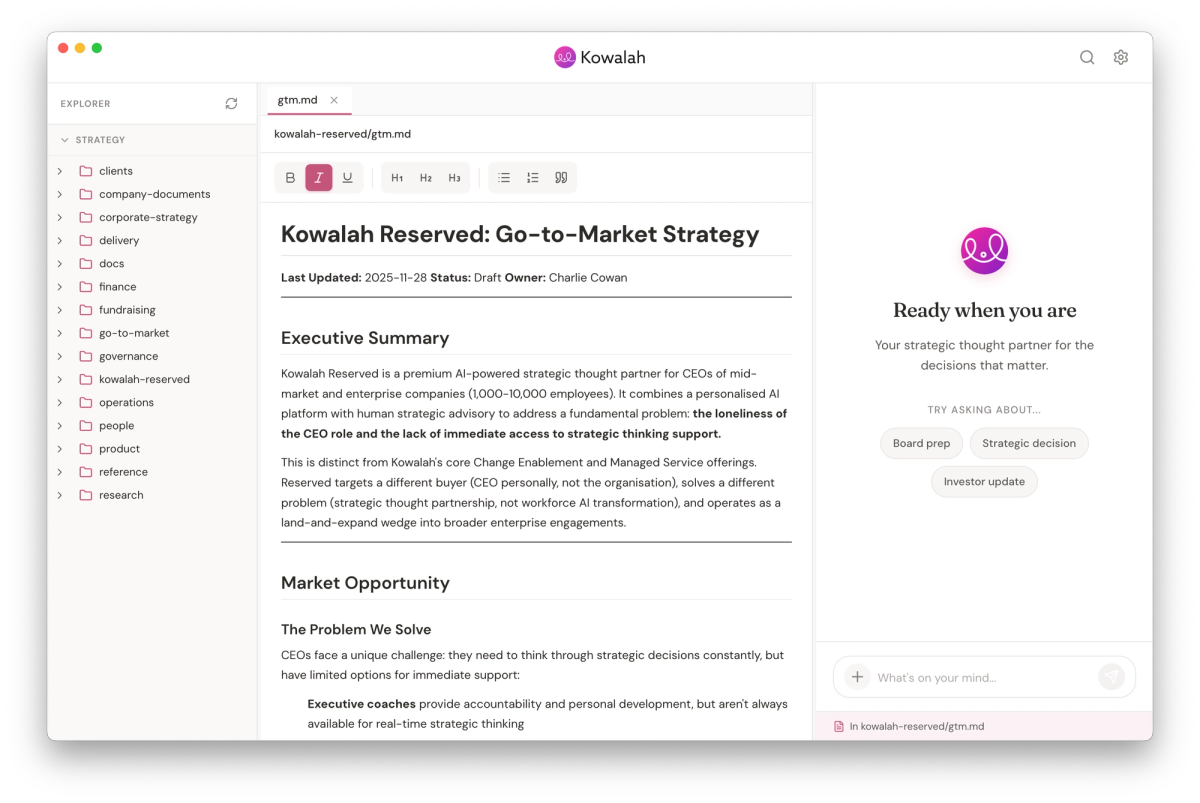
Every time I tackle one of these, the skill doesn't just help me execute. It holds me accountable to my wider strategic context.
Example: I'm updating our go-to-market strategy. The skill reminds me we agreed not to hire for certain roles yet. It asks why I'm considering a channel that contradicts our positioning work. It connects dots across conversations I had weeks ago.
This is what sets skills apart. They navigate your full context. You don't get fixated on one track because the skill sees the whole board.
That's why I end up talking to Claude constantly. It has the nuance of someone who's been in every strategic conversation, read every document, and remembers every decision.
Real Examples: Skills Senior Leaders Are Building
Here's what this looks like in practice for executives leading 1,000-5,000 person organizations:
Board & Investor Relations
- Board meeting prep (synthesizes performance data, flags strategic contradictions)
- Monthly investor updates (structured interview → formatted communication)
- Crisis communication planning (maintains tone and key messages under pressure)
Strategic Decision-Making
- M&A evaluation (applies your investment criteria, challenges blind spots)
- Market expansion analysis (remembers why you exited certain markets, prevents backtracking)
- Competitive positioning reviews (applies frameworks like Playing to Win consistently)
Executive Hiring & Succession
- C-suite role definition (maps capabilities to strategic gaps)
- Executive interview prep (generates questions based on critical competencies)
- Succession scenario planning (stress-tests bench strength against strategic priorities)
Organizational Planning
- OKR cascade and review (connects team objectives to enterprise strategy)
- Reorganization planning (evaluates structure against strategic direction)
- Budget allocation decisions (challenges requests against stated priorities)
Executive Communication
- All-hands messaging (maintains consistent narrative across quarterly updates)
- Executive memo reviews (applies Smart Brevity principles, tightens thinking)
- Town hall Q&A prep (anticipates tough questions based on recent decisions)
These aren't generic AI prompts. They're customized to how you think, the frameworks you trust, and the decisions you've already made.
The pattern? Document your decision-making process once. Get challenged on it every time.
Watch me write this blog post using a Skill
What Holds Leaders Back (And Why These Barriers Are Smaller Than They Seem)
"I'd need to code this."
Not quite. You have a conversation. You explain your process. You describe what questions you want to be asked. Claude builds it.
"This is probably complicated."
Actually, if you have Claude Pro or Claude Max, go to settings, enable skills, and use the pre-built "skill creator" skill. It interviews you and builds your first skill in minutes.
"I'm not technical enough for this."
If you can describe how you think through a problem, you can build a skill. It's documenting your process, not writing software.
The word people keep using is "intimidating." I get it. But that's a knowledge gap, not a capability gap.
Your First Skill: Start Here
Build something you do repeatedly. Something with a process you wish you didn't have to re-explain every time.
For me, it was the CEO strategy toolkit. Sub-skills for GTM updates, pricing reviews, hiring decisions, forecasts.
For a VP of Sales, it might be a deal review skill. For a CFO, a board prep skill. For a product leader, a roadmap prioritization skill.
The pattern is the same:
- Describe your process
- Explain the frameworks you use (Playing to Win, SWOT, whatever you reference)
- Tell Claude how you want to be challenged
- Define what outputs you need
That's it. You've built a tool that remembers your context and challenges your thinking.
Why This Matters Now
You've already proven AI is useful. You're getting value every day.
Now we're entering the "how do I get real leverage?" phase. The executives who figure this out first build strategic advantages, not because they have better AI tools, but because they've customized AI around their specific context, frameworks, and way of working.
Heading into 2026, this is your competitive edge: a strategic partner that knows your business as well as you do.
Key Takeaways
- Skills turn AI from Q&A tool into strategic partner
- They remember your context across every conversation
- They are able to take action - creating files, updating systems
- Building them requires zero coding - just describe your process
- The barrier is knowledge and fear, not technical capability
- Start with something you do repeatedly
Try This
If you have Claude Pro or Claude Max, or your company has a Claude Team or Enterprise account:
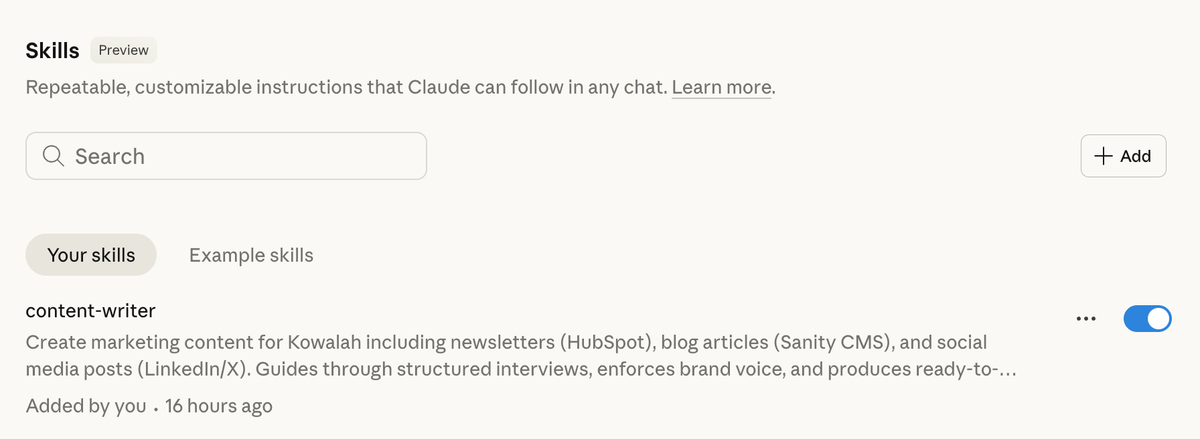
- Go to Settings → Capabilities
- Enable Skills
- Use the pre-built "skill creator" skill
- Build a skill around one process you do every month

Start with something simple. Deal reviews. Weekly planning. Board prep. Something with a clear process.
Build it. Use it twice. You'll see the shift from assistant to partner.
---
Want to See This in Action?
Kowalah helps leadership teams build custom AI workflows that fit how they actually work. Not generic tools. Strategic partners.
Go Deeper
Ready to implement what you've learned? These free resources will help:
- AI Policy Template – Develop an AI-positive policy to share with your organisation and encourage AI experimentation
- AI Use Case Discovery Workshop Template – Gather business requirements and ideas from your functional teams
- GPT Designer – Build your own mini assistant to use in your ChatGPT workspace